


Beyond Bitcoin
At risk of great oversimplification, DeFi, or decentralized finance, use cryptocurrencies to take the intermediary out of financial transactions. Two people in two different places can have a secure financial transaction by way of cryptography, which “encodes” trust in the transaction.
But the deeper lesson is actually one about collaboration. The underlying technologies powering DeFi — cryptography — can enable trust and coordination at the edge when secure digital information is transferred over a network not wholly under your control, without a centralized intermediary.
The tangible applications of cryptography today (ok, beyond data protection and encryption) are, admittedly, most visible via cryptocurrencies. But DeFi is merely the beachhead. The promise of decentralized operations — DeOps — for government institutions and private businesses alike has the potential to upend how information is shared, how security is understood, and how trust is engineered.
Identity
Today, identities are proven manually. You show your ID at the bank. If you’re calling them, you give them your social security number. If you’re banking in your app, you login via password or biometric authentication (and hopefully you have 2FA turned on). All of those mechanisms allow the bank to trust that you are, in fact, you.
In the purely digital realm, this becomes more complicated. You need a digital proof of identity. That’s where cryptographic keys come in — specifically, asymmetric keys, which consist of a public and private key. They’re mathematically linked, and the math only works in one direction: Knowing someone’s public key doesn’t allow you to know what their private key is, which is the security guarantee.
Use of the private key proves information came from you or lets you access something only meant for you. The public key lets anyone send you information or enables anyone to verify that you generated information.
In secure government facilities, it looks something like this: A user inserts their CAC card — yes, a physical card — into a reader that’s plugged into their computer. Their CAC card has a private key, which the computer uses to verify that the person is who they say they are before logging them into their computer.
It’s more secure than entering a password, but it’s still an overtly manual workflow — and it only proves who you are, not what you’re allowed to do.
Credentials = Identity + Authority
Organizations can give users verifiable credentials with attributes like certifications and security clearances. So not only would your private key prove you’re you, but baked on top of your identity is trusted, mathematically provable validation of the information you can and cannot access based on security clearance level, certifications, and so on.
Verifiable credentials via cryptographic proofs are where the real power emerges. Security clearances can go into the field. On any mobile device, you could prove you’re you and you have, for example, Secret clearance.
And when we extend this idea beyond people, trust grows further.
Imagine a U.S. Marine and an Australian counterpart are operating together in the field with no connection to either nation’s enterprise network. They need to coordinate a drone strike — the American has the coordinates, imagery, and timing information and the Australian has the drone.
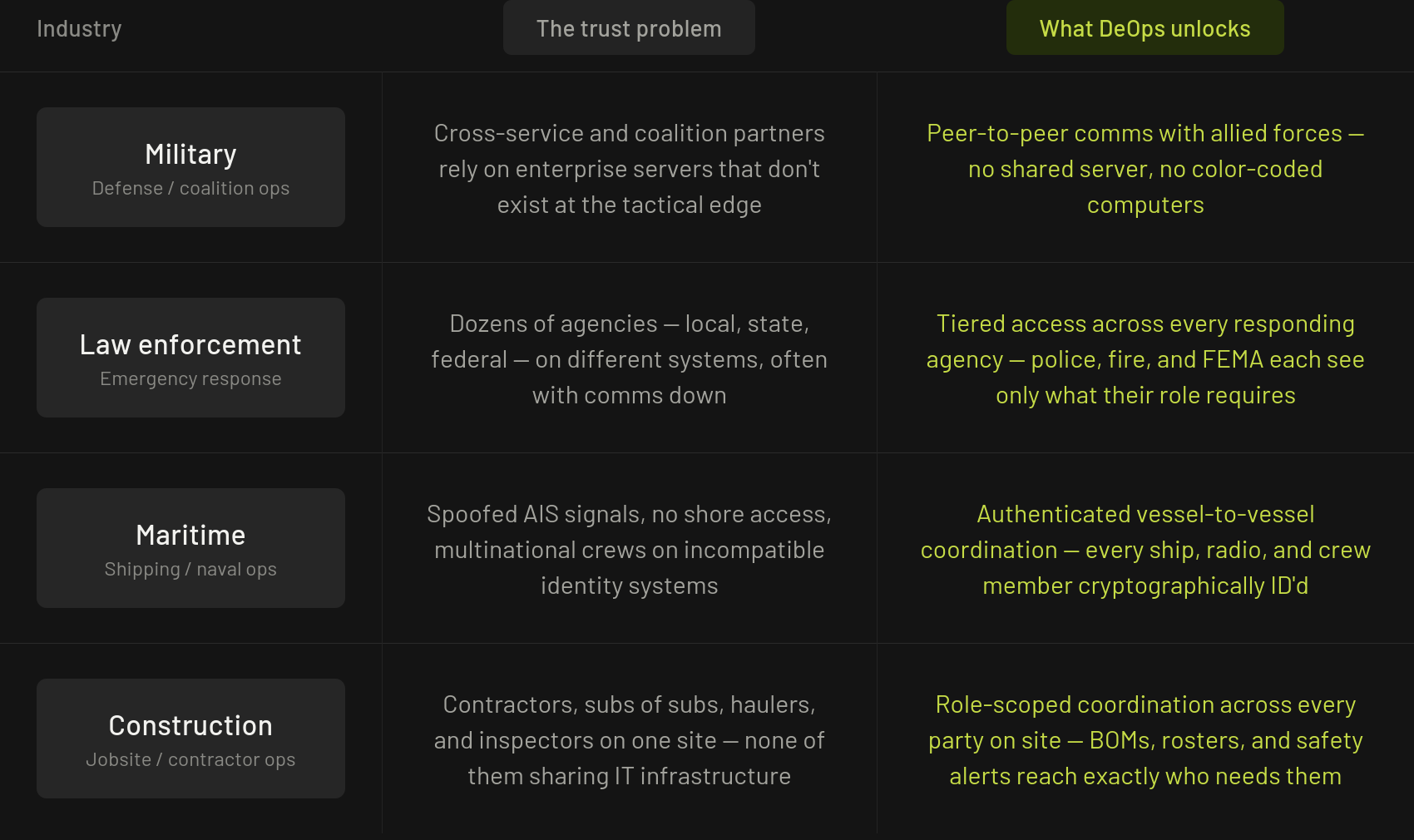
To confirm strike authorization, the American doesn’t call back to HQ or route through a shared server that doesn’t exist at their location. He presents his cryptographic identity directly to the Australian’s UAV. The Australian’s system verifies peer-to-peer that this is, in fact, a U.S. Marine with the authority to call the strike. The target package transfers — signed, attributed, and tamper-proof. The Australian sees everything he needs to put the asset on target. He doesn’t see the source intelligence that generated the coordinates, because his credentials don’t authorize it, and he never has to ask why.
No swivel chair, color-coded computers, or calling back to anyone.
That’s trust engineered for the edge. That’s DeWar — decentralized military operations for American and allied Armed Forces.
DeWar
Collaboration and security aren’t in tension. They’re the same problem.
In order to have effective collaboration at the edge across institutions, those same institutions must be able to restrict certain information from other parties. They want their partners to see what they need to see to work together effectively, but not see everything.
Take a U.S. soldier. If he or she wants to have a secure interaction with a U.S. sailor, they put their CAC card into their computer, their computer verifies who they are, they send an email to their Naval counterpart, and their Naval counterpart’s public keys validate that the information was indeed sent from that particular soldier.
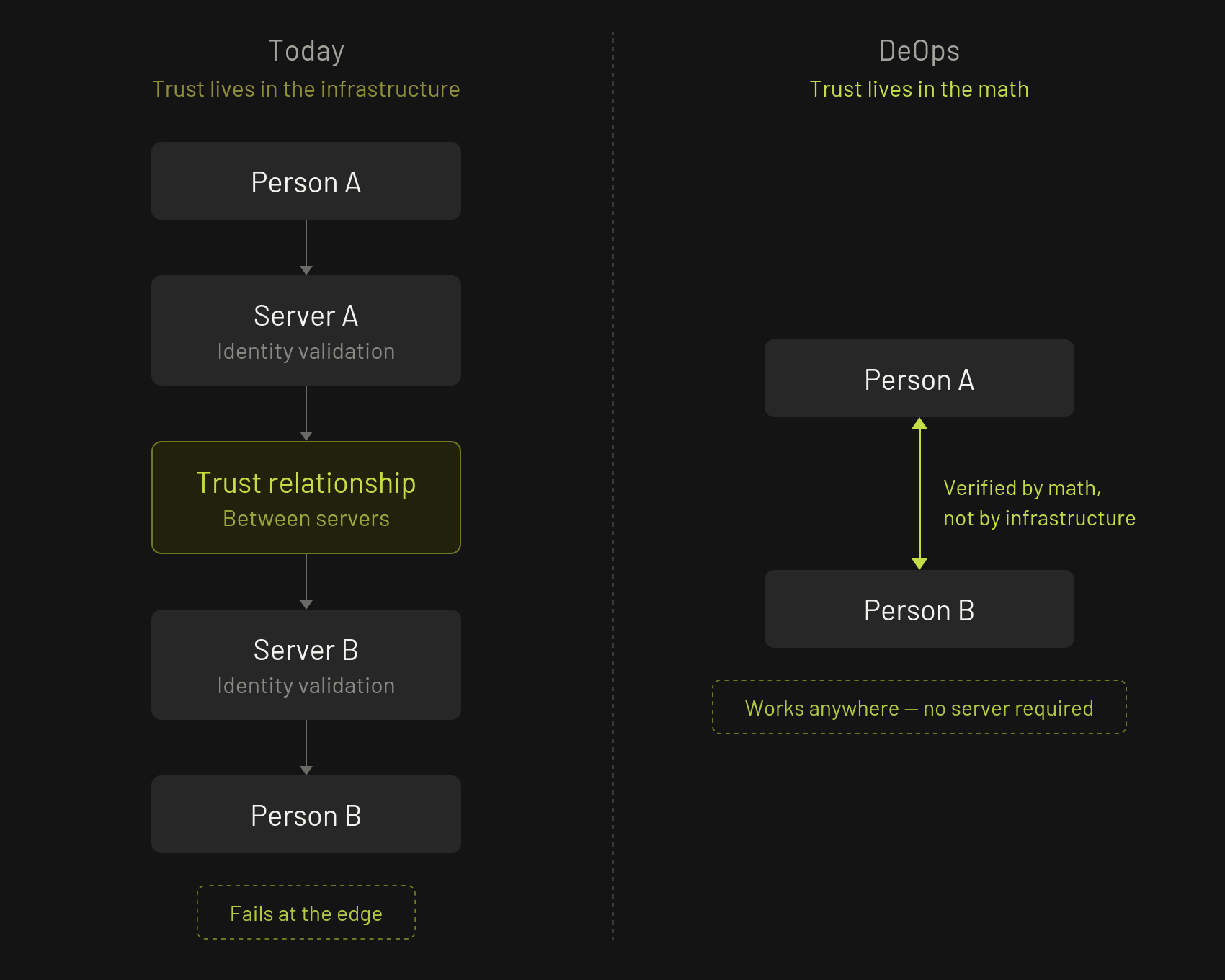
Now, the soldier and sailor aren’t actually doing this — it’s the trusted relationship between the U.S. Army’s A365 server and the U.S. Navy’s FlankSpeed server doing the identity validation. Just like two banks are responsible as intermediaries for authorizing payments between two people, the two email servers are responsible as intermediaries for authorizing communication between two people.
This is the standard mode of creating trust between two entities across organizations, like a soldier and a sailor, and an intra-service example between the Army and Navy is the simplest version of digital trust. Ultimately, they are both part of the Department of War.
Digital trust becomes more complicated when we think about markedly different institutions. Even with our allies, we have, at best, different color-coded computers on base. A red computer for US systems that allows you to email certain countries, a yellow computer for other US systems that lets you email some US agencies and some other countries, a pink one that lets you email a different set of countries but not most US users and so on.
It’s not great, but it functions — with varying degrees of effectiveness. In the air conditioning. At HQ. With a Keurig machine and hardwired ethernet connection.
In the field? The standard mode of creating trust breaks — completely.
DeWar: Applied
Coalition and partner forces
Sharing data securely with partner forces in a tactical environment is technologically feasible. DeWar enables two people who are completely disconnected from any centralized authority, like an email server, to have a secure and trusted digital interaction with one another.
In the Indo-Pacific, a U.S. Special Forces soldier should be able to securely and easily communicate with a South Korean soldier without a special device, swivel chairing to a different system, or color-coded computers. In Europe, digital coordination between the disparate forces fighting Russians on the battlefield should be the norm.
It’s not.
A failure to cultivate and deploy technologies to enable trusted collaboration at the edge is a problem for organizations far beyond allied militaries.
From DeWar to DeOps: Beyond the military
Law enforcement
State and local law enforcement and emergency management agencies might need to collaborate digitally, in the field, with each other and federal agencies during a natural disaster. There might be local police, Sheriff’s deputies, Disaster Survivor Assistance (DSA) Specialists from FEMA, firefighters, and emergency responders, all who might need to collaborate. In the throes of emergency response, volunteers likely shouldn’t need access to all the information a Sheriff’s deputy might. The marriage of coordination and security is possible with DeOps.
Maritime
A vessel in contested or remote waters can’t always trust what centralized systems are telling it. AIS signals can be spoofed, shore-based networks may be unreachable, and coordination between ships from different nations or operators means you’re dealing with identity systems that don’t talk to each other. Every ship and every radio gets its own cryptographic identity.
Every person aboard does too. A distress call authenticated cryptographically carries a provability that a broadcast over open radio never could. The officer on watch knows not just that a signal was received, but who sent it, that it hasn’t been tampered with, and whether the sender is who they claim to be — without routing that verification through a shore-based server that may be unavailable or compromised. The marriage of coordination and security is possible with DeOps.
Construction
Construction is the foundation of the global economy. Factories, homes, roads, data centers, new energy infrastructure — it all starts with construction. Multi-national construction conglomerates are distributed operations manifest. They have crews on job sites all over the world, many of whom are contractors, subcontractors, and subcontractors of subcontractors. There are material haulers and safety inspectors and OEM providers too, and none of them share an IT infrastructure.
Delivering a bill of materials, sharing safety information, managing crew rosters and crew shifts securely without exposing what they shouldn’t is a genuine operational problem. The crew doing earthmoving with 80-ton excavators needs to coordinate with the foreman and the dump truck drivers. The excavator operators don’t need to see shifts and schedules for the rest of the crew. Everyone involved on a site needs varying degrees of access to safety information and protocols across subcontractors and service providers. A safety incident requires instant communication across every party on site.
With DeOps, each worker and each device carries a cryptographic identity and the credentials that define exactly what they’re authorized to see — no central server required, no IT department standing between the crew and the coordination required in the moments it matters.
The edge is everywhere
The math has been there for decades. The algorithms that make Bitcoin work are the same algorithms that could enable a Special Forces soldier to authenticate a South Korean counterpart in a denied environment — decentralized warfare in action.
But these principles extend beyond war. They let a FEMA specialist share only what a volunteer needs to see or let an offshore crew coordinate a safety response without a shore-based server in the loop.
None of this requires new physics. It requires treating cryptography as operational infrastructure. GPS and encrypted radio are two longstanding technologies that became foundational to how military forces operate. Modern institutions, like our military, need to evolve.
If we get trust at the edge right, the game changes.
Disconnection does not mean vulnerability.
Trust becomes something you carry with you, not something you have to return to base to establish.
Collaboration becomes truly frictionless.
In an era defined by a rising global threat environment, we can accept nothing less.